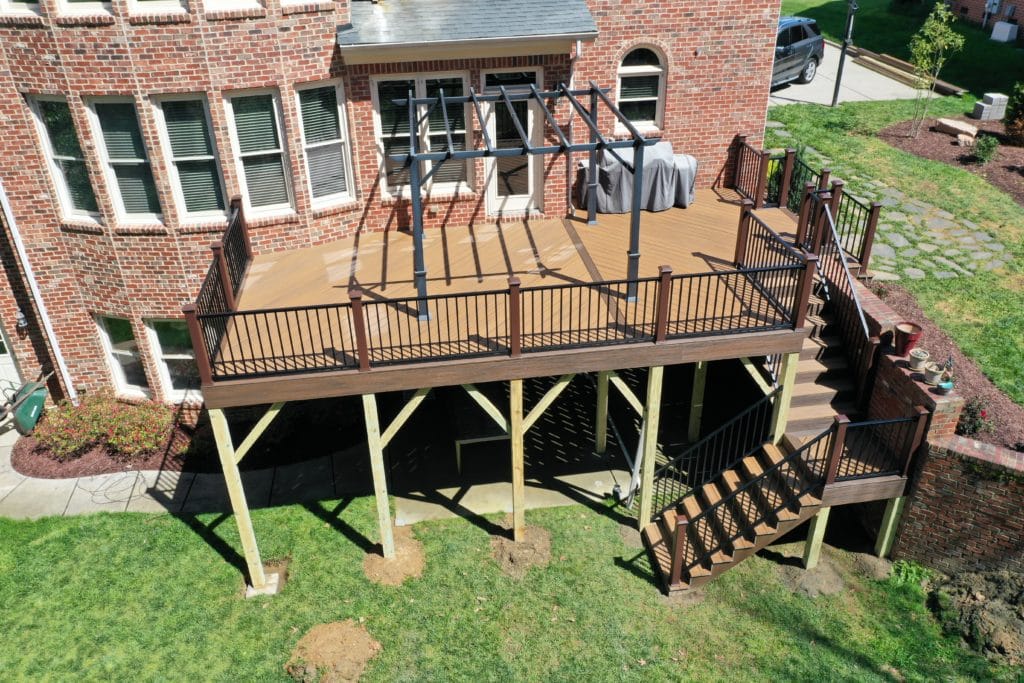
If your deck boards are cracked, splintered, or faded, the obvious question is whether you need a whole new deck.
Often you don’t.
Deck resurfacing replaces the surface you see and walk on while keeping the structure underneath.
Deck replacement starts over from the ground up.
This guide explains how to tell which one your deck needs, using the same checks our crews make on Charlotte-area decks.
The key point: the condition of the frame decides it, not the condition of the boards.
Short answer: resurface when the frame, posts, footings, and ledger connection are solid and only the decking, railings, or stairs are worn out. Replace when the frame has rot, the ledger isn’t properly attached and flashed, the footings have shifted, or the deck no longer meets current code. A contractor’s inspection of the structure is what settles it.
What’s in this guide
- What is deck resurfacing?
- What does a full deck replacement include?
- How a contractor decides: the frame inspection
- Signs your deck frame is past saving
- When resurfacing is the smart choice
- Upgrading to composite during a resurface
- What about railings and stairs?
- What to expect from the process
- Frequently asked questions
What is deck resurfacing?
Deck resurfacing means removing the old deck boards and installing new ones on the existing frame.
The joists, beams, posts, and footings stay where they are.
Most resurfacing projects also replace the railings and stair treads, since those usually wear out on the same schedule as the boards.
Resurfacing is not the same as refinishing.
Refinishing keeps your existing boards and cleans, sands, and re-stains them.
It works when the boards are still sound but look tired.
Our guide to deck maintenance covers that routine care.
Resurfacing is for boards that are past the point where stain can help.
What does a full deck replacement include?
A full deck replacement removes everything down to the ground, including the boards, frame, posts, and usually the footings.
The new deck is then built like any new deck, with fresh footings, framing, a properly attached ledger, and new decking and railings.
Because it starts from scratch, replacement is the chance to change the deck itself.
You can make it bigger, change its shape, add a second level, or plan for a screened porch on top.
If you’re already weighing a new layout, our deck building services in Charlotte page walks through design options and materials.
How does a contractor decide between resurfacing and replacement?
A contractor decides by inspecting the structure under the boards, piece by piece.
If every load-carrying part checks out, resurfacing is on the table.
If any of them fails, the conversation shifts to repair or replacement.

The ledger and its flashing
The ledger is the board that attaches the deck to your house, and it is the most important connection on most decks.
It should be bolted or lag-screwed to the house framing, not just nailed.
The American Wood Council’s prescriptive deck construction guide also requires corrosion-resistant flashing wherever a ledger meets a wood-framed wall.
Without flashing, rainwater runs behind the ledger and rots both the ledger and the house framing behind it.
Joists and beams
Joists are the parallel boards the decking sits on, and beams carry the joists.
A contractor looks for soft spots, rot at the ends and on top edges, cracks, and sagging.
The tops of joists take the most water, because moisture collects under every deck board.
Posts and footings
Posts carry the deck’s weight down to the footings, the concrete supports in the ground.
The inspection checks for rot where posts meet the ground and for footings that have settled, heaved, or cracked.
North Carolina’s residential code calls for footings at least 12 inches below grade, and some older decks were built on less.
Hardware and connections
Joist hangers, bolts, and screws hold everything together.
Heavy rust, missing fasteners, or hangers pulling away from the ledger are all warning signs.
Treated lumber is hard on plain steel, so older hardware often corrodes even when the wood looks fine.
Ready to upgrade your outdoor space?
See how A Deck Above brings your deck, patio, or pergola vision to life.
What are the signs your deck frame is past saving?
Your frame is likely past saving if the rot or damage is spread across many parts, not isolated to one or two boards.
Watch for these signs:
- Soft or spongy joists. A screwdriver sinks easily into the wood.
- Rot at the ledger. Dark, crumbling wood where the deck meets the house.
- A deck that sways or bounces. Movement when people walk across it.
- Sinking or leaning posts. Uneven railings or a visible tilt.
- No flashing over the ledger. Water has likely been getting behind it for years.
- Nails instead of bolts at the ledger. A connection that doesn’t meet today’s standards.
One soft joist can often be repaired by adding a new joist alongside it.
Widespread rot is different.
Putting new boards on a failing frame means paying for a new surface that you’ll tear off again when the structure gives out.
Our deck safety guide covers more of the warning signs to watch for between inspections.
When is resurfacing the smart choice?
Resurfacing makes sense when the structure is sound and you’re happy with the deck’s size and layout.
It’s usually a good fit when:
- The boards are cracked, splintered, cupped, or rotting, but the joists underneath are solid.
- The ledger is properly bolted and flashed.
- Posts and footings are plumb and stable.
- You want a lower-maintenance surface without changing the deck’s footprint.
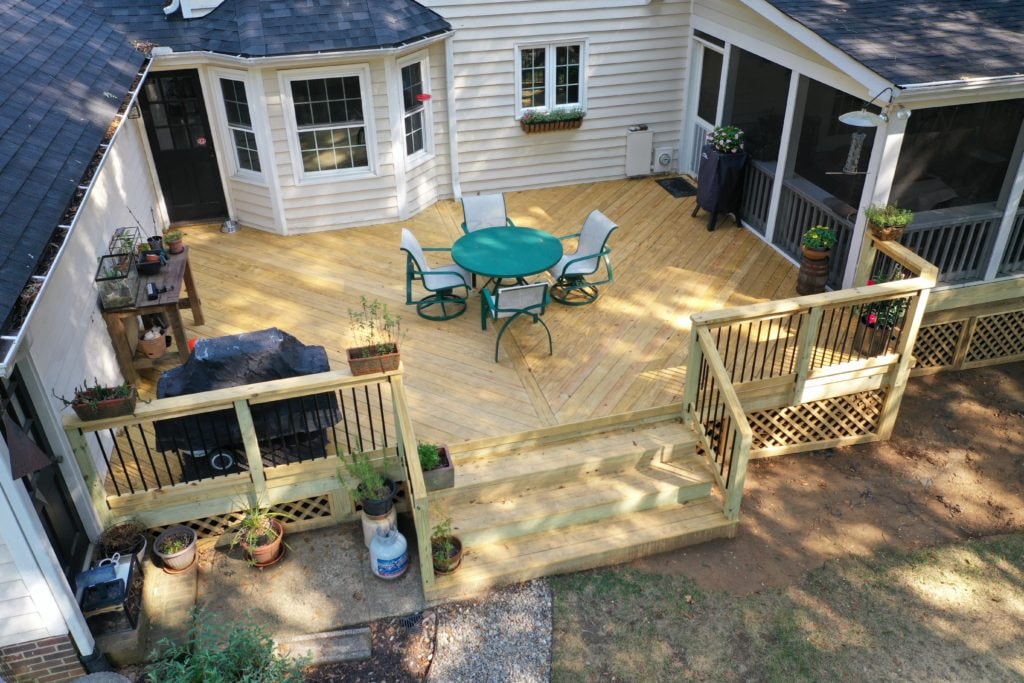
Resurfacing usually costs noticeably less than a full rebuild, because the frame and footings stay in place.
It’s also faster and less disruptive to your yard.
If you like your deck’s shape and the bones are good, it’s often the best value.
Can you upgrade to composite decking during a resurface?
Yes, and it’s one of the most common reasons Charlotte homeowners resurface.
Composite brands like Trex and TimberTech and AZEK don’t need staining, won’t splinter, and hold up to our humid summers.
The catch is what’s underneath.
Trex’s joist installation guide calls for joists no more than 16 inches apart for standard layouts, and 12 inches apart for diagonal boards.
Some older wood decks were framed with wider spacing.
On those decks, extra joists are added between the existing ones before the new boards go down.
That added framing is a normal part of a composite resurface, not a sign anything is wrong.
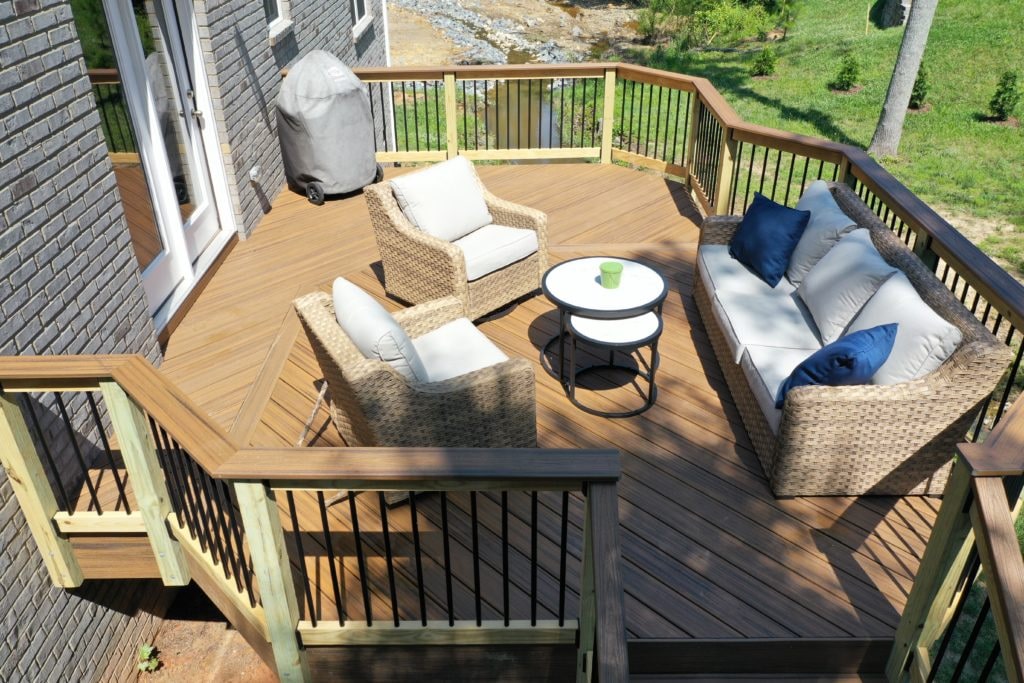
Composite decking also lasts a long time, which makes a sound frame even more important.
Our article on how long a composite deck lasts covers what to expect.
You don’t want new boards to outlive the structure holding them up.
Get a free estimate from A Deck Above
Tell us about your project and we’ll help you plan the space you’ve been picturing.
What about railings and stairs?
Most resurfacing projects replace the railings and stairs too, since they age at the same pace as the boards.
Railings are also a safety item, so they have to meet current code.
North Carolina’s residential code requires a guardrail at least 36 inches high on any deck more than 30 inches above the ground.
Older decks sometimes have railings that are too short, too loose, or spaced too far apart.
New railings fix that and change the look of the whole deck.
Aluminum, composite, and black metal balusters are popular upgrades.
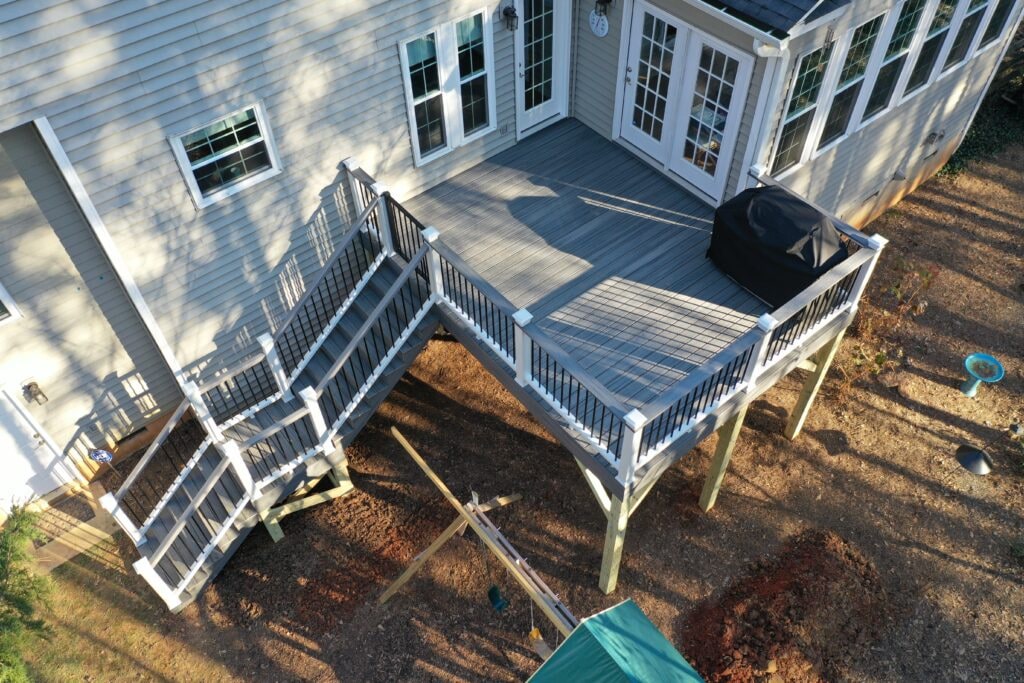
What should you expect from the process?
Whether your deck needs resurfacing or replacement, the process follows the same basic steps.
1. Inspection and consultation
A contractor checks the frame, ledger, posts, footings, and railings.
They should tell you plainly whether the structure can be reused, and why.
2. Materials and design
You choose decking, railings, and any upgrades.
Our composite decks page is a good starting point for comparing options.
3. Permits when required
A full replacement goes through your county’s permit and inspection process.
A resurface may or may not need one, depending on the scope.
A Deck Above handles permits for you.
4. Tear-off and build
The old boards, or the whole deck, come off.
Any frame repairs or added joists come next, followed by new decking, railings, and stairs.
5. Final walkthrough
You walk the finished deck with the crew and get care instructions for your new surface.
Frequently asked questions
What is the difference between deck resurfacing and deck replacement?
Resurfacing replaces the boards you walk on, and often the railings and stairs, while keeping the existing frame, posts, and footings. Replacement tears the whole deck down and rebuilds it from new footings up. Which one fits depends on the condition of the frame, not how worn the boards look.
How do I know if my deck frame is still good?
A sound frame has solid joists, beams, and posts with no soft or crumbling wood. The ledger is bolted to the house with flashing above it, and the hardware is free of heavy rust. Probing suspect spots with a screwdriver is a quick first check, but a contractor’s inspection is the reliable answer.
Can I put composite decking on my old wood frame?
Often, yes, if the frame is sound and the joists are spaced closely enough. Trex calls for joists no more than 16 inches apart for standard layouts and 12 inches for diagonal boards. Frames built with wider spacing need extra joists added before composite boards go down.
Is resurfacing cheaper than replacing a deck?
Usually, because the frame, posts, and footings stay in place, so there is less demolition, material, and labor. The savings disappear if the old frame needs heavy repairs first. In that case, a full replacement is often the better long-term value.
Do I need a permit to resurface or replace a deck in Charlotte?
A full replacement is new construction, so it goes through the county permit and inspection process in Mecklenburg or Union County. Whether a resurfacing job needs a permit depends on its scope, especially if railings or stairs change. A Deck Above confirms that and handles any permit before work starts.
Not sure which your deck needs?
The fastest way to know is to have the frame looked at by someone who builds decks every week.
Schedule a free estimate, and we’ll tell you whether your deck can be resurfaced or needs to be rebuilt.
Not sure if your deck needs resurfacing or replacing?
Get a free estimate and an honest look at your deck’s frame from the A Deck Above team.
Get a Free Estimate